Most people start a move by asking what it costs. That is the wrong first question, not because price does not matter but because the answer depends entirely on a scope nobody has written down yet.
The better first question is which service you actually need. A studio going four miles across town, a four-bedroom house going to Denver, one armoire going up a flight of stairs, and an office floor coming out at lease exit are four different jobs with four different plans. Sorting that out first makes every quote you receive comparable, which is the only way to tell a good one from a bad one.
This guide covers how to place your move into the right category, then points you to the guide for it.
Direct answer: Three inputs decide which moving service fits. Your inventory, meaning what is actually travelling rather than what is in the house. The buildings at both ends, meaning stairs, elevators, gates, and where a truck can legally stand. And the distance, which determines whether the move runs under intrastate or interstate authority. Write those three down before you contact anyone, and the service selection becomes obvious rather than a sales conversation.
Short answer: how to choose a moving service in Austin
Start with the inventory, because volume drives the crew and the truck. Then look at both buildings, since access determines how long the same volume takes to move, and a long carry or a shared elevator can matter more than an extra bedroom. Then check the distance, which sets whether the job is local, intrastate, or interstate, and which registrations apply. Only then decide on add-ons like packing, storage stops, or single-item handling. A quote built in that order reflects the real job. A quote built from a phone guess about square footage does not.
First: verify before you compare
Before any of the service selection matters, do the one check that separates legitimate carriers from the rest. Texas motor carriers are registered, and the registrations are public.
Pro Alliance Services LLC operates under USDOT 3348909, MC 1132579, and TxDMV 010320594C. You can look those up, and you should look up any competing bid the same way. The TxDMV consumer protection resources explain what to check and why, and the registry itself lives on the TxDMV site. It takes about a minute and it is the single most useful minute in the whole process.
Local moves inside the metro
If both addresses are in the Austin metro, the plan is driven by access rather than distance. Five miles across town through a building with a shared freight elevator can take longer than twenty miles between two houses with driveways.
That is why the access questions come first. Where the truck stands, what the building requires, how far the carry runs, and what has to be disassembled to get through a doorway. The Austin metro moving access guide covers those in detail.
Two specific situations get their own guides. If you are moving into an apartment or mid-rise, read the Austin apartment and mid-rise guide, because a property manager controls most of your schedule. If you are moving house, the Austin house moving guide covers garage and attic contents, yard equipment, and closing-day timing.
Moves leaving the region
Once the destination is outside the metro, the questions change. Interstate moves run under federal authority and intrastate moves under state authority, and the biggest risk is not distance but brokers, who sell your move on to whoever takes it.
The long-distance moving from Austin guide covers how to tell a carrier from a broker and how to plan access at a destination you cannot visit.

Packing, and how much of it to hand over
Packing is the most common add-on and the one people most often get wrong in both directions. Paying to pack a garage full of things you were going to throw away is waste. Packing your own kitchen the night before a move is usually a false economy, because glassware and dishes are where damage concentrates and where crew time disappears.
The Austin packing services guide covers how to decide room by room rather than by package name.
Single items and installation work
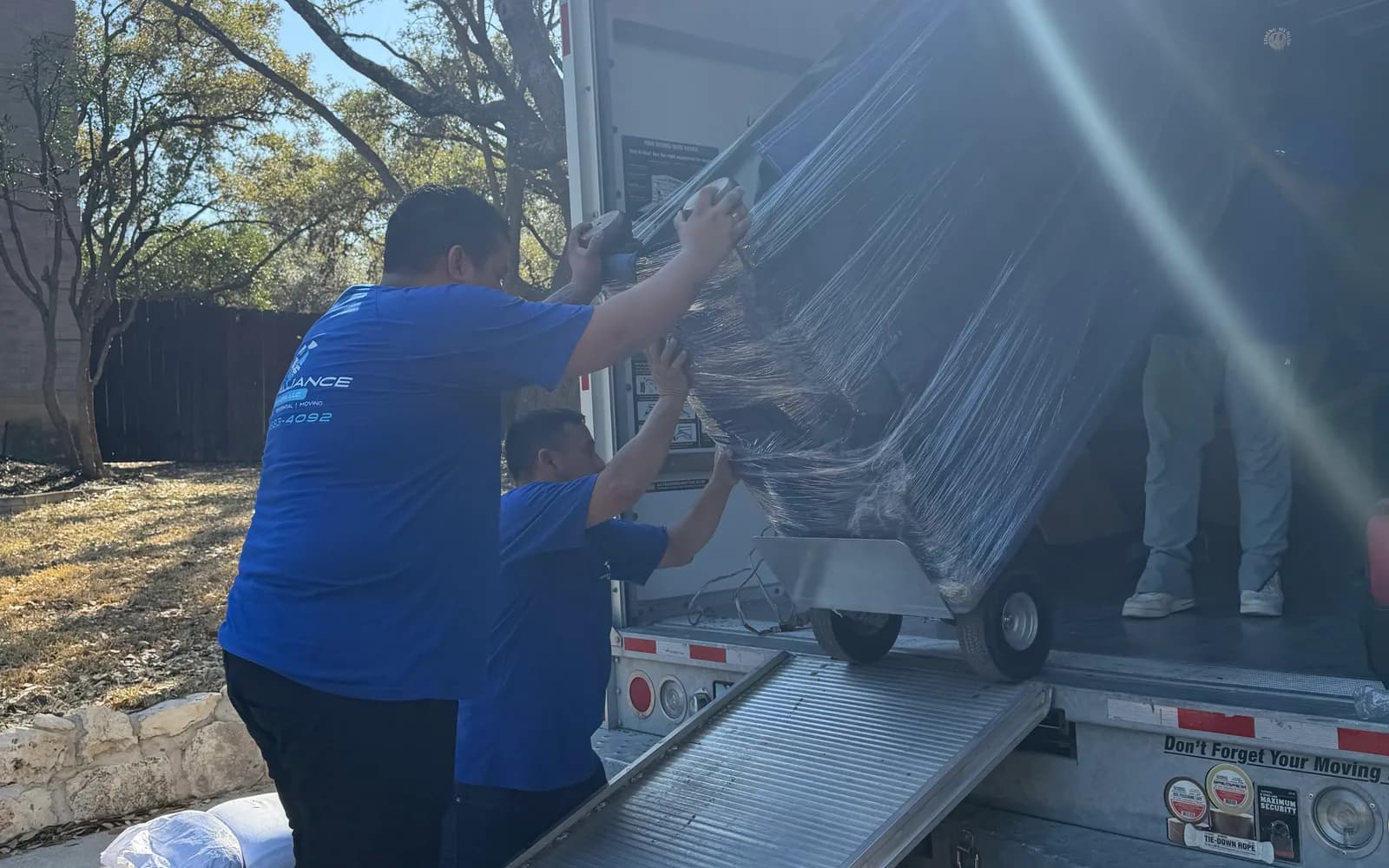
Not every job is a household. A piano, a gun safe, a treadmill, or one sofa going up a flight of stairs is quoted on the route rather than the volume: the tightest turn, the door width, the stairs, and whether the piece can be disassembled. The Austin furniture and single-item moves guide covers that.
Assembly and installation is a separate category again, whether that is flat-pack furniture at a new address or workstation installs in an office. See the Austin furniture installation and assembly guide.
Commercial work
Business moves split in two. A relocation moves a working operation from one address to another and lives or dies on sequencing, which the Austin office move planning guide covers. A decommissioning empties a space at lease exit and is governed by the restoration clause in the lease rather than by where anything is going; see the Austin office decommissioning guide.
When storage sits in the middle
Sometimes the dates do not line up and the household goes into a storage unit between addresses. That changes the load order and adds a second set of access rules, and it is worth planning as one job rather than two. The Austin moving and storage stop guide covers it.
What to send when you request a quote
- Write a room-by-room inventory of what is actually moving, not what is in the house.
- Call out large, fragile, and high-value pieces separately.
- Give both full addresses, including unit numbers and gate codes.
- Say where a truck can legally stand at each address, and for how long.
- Note stairs, elevators, and the carry distance from the truck to the door.
- Measure the narrowest doorway and the tightest interior turn on the route.
- Send any building or association requirements in writing, including insurance wording.
- Give your preferred date and say how flexible it is.
- Say which add-on services you are considering, so they are priced rather than assumed.
If you want to understand what actually moves the number rather than the service selection, the Austin moving cost factors guide covers that separately.
Where Pro Alliance fits
Send the nine items above and the team reviews the scope and access at both ends before preparing a written estimate. Start from the services page or the Austin movers page, then use the free estimate form.
Frequently asked questions
How do I know whether a mover is legitimate?
Look up the registration numbers. Texas carriers hold TxDMV authority and interstate carriers hold USDOT and MC numbers, all publicly searchable. Ask any company for its numbers and check them before you discuss price.
What is the difference between a mover and a broker?
A carrier operates the trucks and crews that handle your move. A broker sells the job to somebody else. Brokers are legal, but you should know which one you are hiring, and the registry tells you.
Do I need packing services?
It depends on the room. Kitchens, glassware, and art are where damage and crew time concentrate, so those are usually worth handing over. Clothes and books are usually worth doing yourself.
Can I get one quote covering a move and a storage stop?
Yes. Tell the team that a storage unit sits in the middle, and give the facility's access hours and any vehicle restrictions. It is planned as a single job rather than two bookings.
How far ahead should I request an estimate?
Earlier gives more scheduling options, particularly at month end and during late-summer lease turnover. It also leaves time to confirm building or association requirements before the date is fixed.
Sources
Ready to plan the real move?
Send both addresses, your date, and what you are moving. The team reviews access at each end and comes back with a written estimate.
Prefer to talk it through? Call (210) 683-4092, Mon–Fri 8:00 AM–5:30 PM and Sat–Sun 8:00 AM–4:30 PM.
Keep planning