Decommissioning is the job nobody budgets for until the lease is nearly up.
It is not a move. Nothing is going to a new office, or at least not most of it. It is the work of returning a space to whatever condition the lease says you owe, on a deadline set by the lease end date rather than by your convenience, and it usually involves more material than the tenant expects because five years of accumulation is invisible until you try to remove it.
The companies that handle this well start by reading the lease. The ones that handle it badly start by calling a hauler.
Direct answer: Start with the restoration clause in your lease, because it defines the entire scope. It tells you what has to be removed, what has to be repaired, what may be left in place, and by when. Then split the contents into three lists: what goes to the new space, what has value and can be sold or donated, and what is waste. Those three lists drive three different logistics plans. Book the freight elevator and dock time early, because everyone exiting a lease wants the same end-of-month window.
Short answer: what an Austin office decommissioning involves
Read the lease restoration clause first: it defines what must be removed, what must be repaired, and the deadline, which is usually the lease end date rather than your move date. Inventory the space and split it three ways, into what relocates, what has resale or donation value, and what is waste. Book the building's dock and freight elevator early, since end-of-month exits compete for the same slots. Plan the disposal route separately from the removal, because electronics and certain materials cannot go into general waste. Then walk the space with your landlord or property manager before the work starts so the standard is agreed rather than argued about afterward.
The restoration clause is the scope
Every commercial lease handles this differently, and the differences are expensive.
Some leases require the space returned to base building condition, meaning tenant improvements come out. Some require only that the space be broom clean with the tenant's property removed. Some are silent on items the landlord would rather keep, which means you should ask rather than assume the cabling and the built-ins are yours to rip out.
Read yours, and if the wording is ambiguous, get the landlord's interpretation in writing before the work starts. A disagreement discovered after the crew has left is a disagreement you lose.
Three lists, three plans
The single most useful thing you can do is stop treating the contents as one category.
What relocates goes to the new address and belongs in the office move plan, scheduled and sequenced with the rest of the relocation.
What has value should be identified early, because resale and donation both take lead time and both stop being options once the deadline is close. Furniture in good condition, particularly recent workstation systems, has more value than most tenants assume.
What is waste needs a disposal route, and that is not a single route. General waste, recyclable material, and electronics go different places. The City of Austin publishes guidance through Austin Resource Recovery, and state-level waste and recycling rules are administered by the Texas Commission on Environmental Quality. Confirm what applies to your material rather than assuming a dumpster covers it.
Workstation teardown
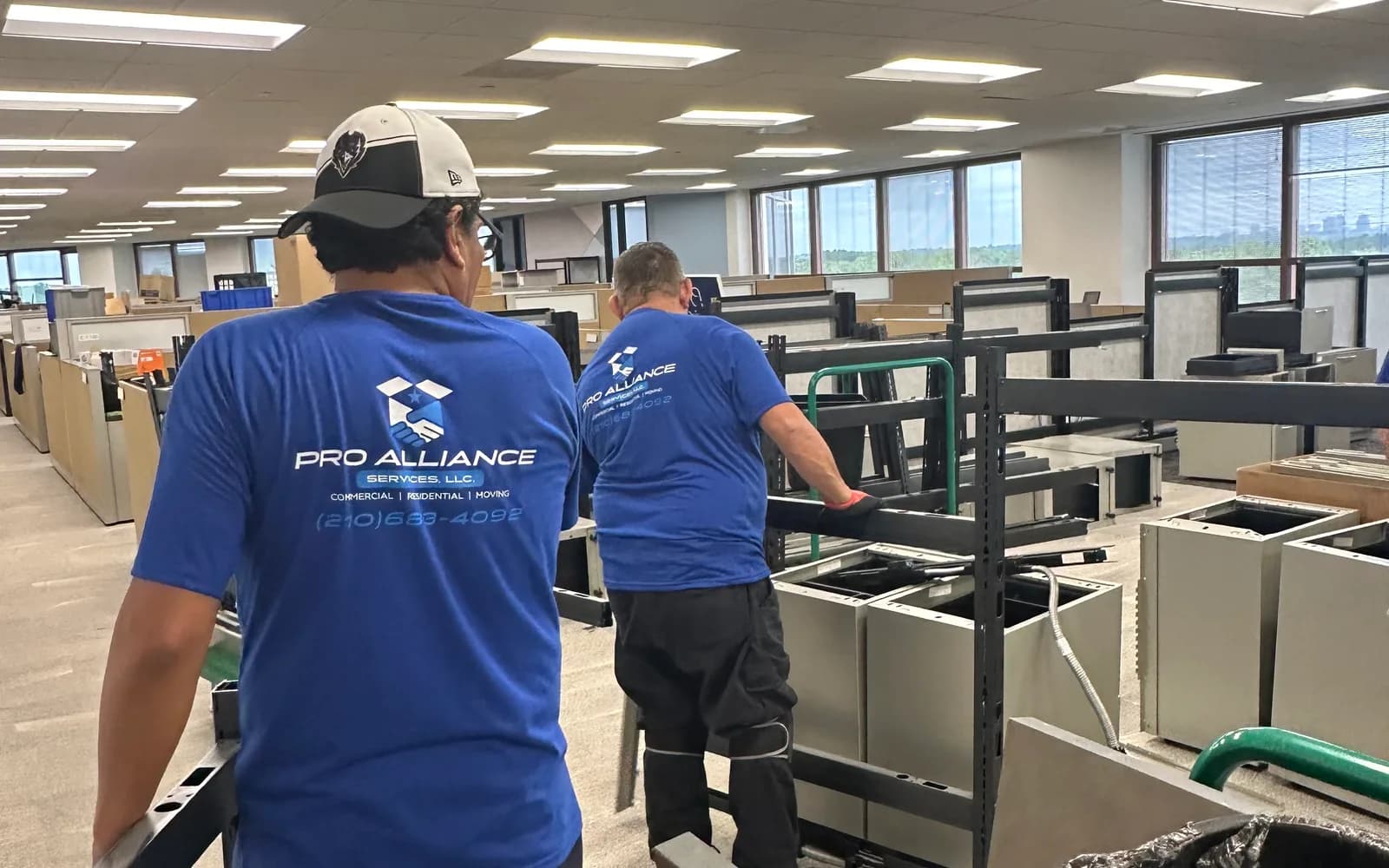
This is where the hours go. Cubicle systems, benching, and modular walls all break down into far more components than they appear to have, and the volume once disassembled is larger than the volume standing up.
Two practical points. First, if any of it is being reused, it needs to be disassembled in a way that keeps the parts matched and the hardware together, which is slower than demolition and worth specifying. Second, if none of it is being reused, say so, because that changes the method entirely.
Book the building early
End-of-month and end-of-quarter lease exits cluster, and the dock and freight elevator are shared. If your deadline is the last day of the month, so is everyone else's.
Get the reservation in writing as soon as the date is known, along with permitted working hours, any after-hours security requirement, and the property's certificate of insurance requirement. Where the work touches the street or the right of way, Austin Transportation and Public Works is the responsible authority inside the city.
Walk the space with the landlord first
Do this before the work starts, not after. Agree what condition the space is being returned in, photograph the existing damage so it is not attributed to the decommissioning, and confirm the standard the landlord expects.
Photograph again when the work is finished. A documented before and after is the cheapest protection available against a deposit dispute.
The decommissioning checklist
- Read the lease restoration clause and note the exact deadline it sets.
- Get the landlord's written interpretation of anything ambiguous in that clause.
- Inventory the space and split contents into relocate, resale or donation, and waste.
- Identify resale and donation items early, while there is still lead time to place them.
- Confirm the disposal route for electronics and any material that cannot go to general waste.
- Book the dock and freight elevator as soon as the exit date is known.
- Obtain the property's certificate of insurance requirement and lead time.
- Walk the space with the landlord and photograph existing damage before work begins.
- Photograph the finished condition and keep the record with the lease file.
Where this sits in the wider batch
If you are relocating rather than only exiting, the Austin office move planning guide covers the other half. San Antonio tenants dealing with the same problem can use the San Antonio office decommissioning checklist and the San Antonio office furniture liquidation guide, which cover resale routing in more depth.
Where Pro Alliance fits
Send the address, the lease deadline, an inventory or floor plan, and the restoration clause wording. The team reviews the scope and the building constraints and prepares a written estimate covering removal and teardown. See the office decommissioning page or the commercial moving page, then use the free estimate form.
Frequently asked questions
What does a restoration clause usually require?
It varies by lease. Some require return to base building condition with tenant improvements removed, others only require the space broom clean with the tenant's property gone. Read yours and confirm anything ambiguous with the landlord in writing.
Can our old furniture be sold instead of scrapped?
Often, particularly recent workstation systems in good condition. Identify those items early, because resale and donation both need lead time and stop being options once the deadline is close.
Where does the waste go?
It depends on the material. General waste, recyclables, and electronics follow different routes, and city and state guidance covers what applies. Confirm the route before the work starts rather than assuming one dumpster handles everything.
When should we book the building's dock?
As soon as the exit date is known. Lease exits cluster at month and quarter end, and the dock and freight elevator are shared with every other tenant on the same deadline.
Is decommissioning quoted the same way as a move?
No. A move is priced from what travels and where it goes. A decommissioning is priced from what has to come out, how it comes apart, and where each category of material ends up.
Sources
Ready to plan the real move?
Send both addresses, your date, and what you are moving. The team reviews access at each end and comes back with a written estimate.
Prefer to talk it through? Call (210) 683-4092, Mon–Fri 8:00 AM–5:30 PM and Sat–Sun 8:00 AM–4:30 PM.
Keep planning