An office move is a scheduling problem wearing a moving problem's clothes.
The furniture is not the hard part. The hard part is that a business has to keep operating, two building managements have to approve everything, and the whole thing usually has to happen outside working hours in a window somebody else controls. Get the sequence right and a floor moves over a weekend. Get it wrong and you have staff on Monday with no desks and a service elevator booked by somebody else.
Direct answer: Plan an office move backward from the two buildings, not forward from your furniture. Get the loading dock reservation, the freight elevator window, and the permitted after-hours access confirmed in writing at both the origin and the destination, along with each building's certificate of insurance requirement. Those four constraints define your window. Then sequence the move inside it by function, taking down what the business can be without first and standing the destination up in the order people need it on the first morning back.
Short answer: how an Austin office move gets planned
Start with the buildings. Confirm dock and freight elevator availability at both addresses, the hours a commercial vehicle may work, and each property's insurance requirement, all in writing. That gives you a window. Then build the sequence inside it: label everything by destination location rather than by origin, take down the systems the business can operate without first, and set up the destination in the order staff will need it. IT and anything on a network gets its own plan, because a desk without a working connection is not a working desk. Confirm the whole schedule with both property managers before you commit to a date.
The two buildings define the window
Everything else is negotiable. This is not.
At each address, get these in writing from property management: whether there is a loading dock and how it is reserved, whether the freight elevator needs booking and whether the window is exclusive, what hours commercial work is permitted, whether after-hours access requires security notification or an escort, and what certificate of insurance the property requires and by when.
Two buildings means two sets of answers, and they will not match. The destination often has the tighter constraint, because you are the new tenant and the property has no history with you.
Where the move touches the street rather than private property, Austin Transportation and Public Works is the responsible authority inside the city, with relevant provisions in the City of Austin Code of Ordinances. Outside the city limits, Travis County applies.
Sequencing by function, not by room
The instinct is to move room by room. The better approach is to move by what the business can be without.
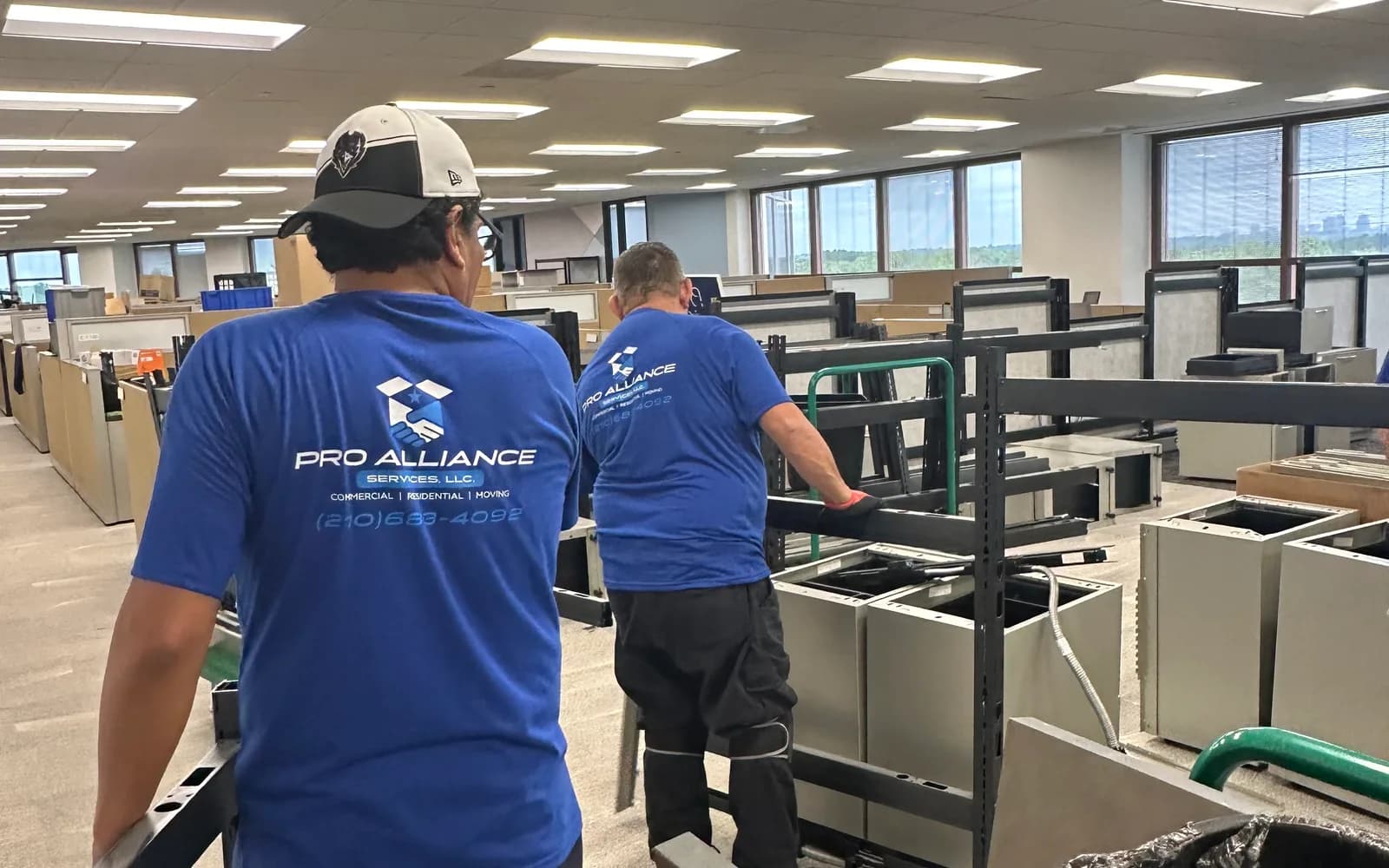
Take down storage, archive, and low-use areas first, because nothing stops when they are in boxes. Take down workstations in groups that map to teams, so a team is either fully up or fully down rather than half working. Leave anything customer-facing or revenue-critical until last, and stand it up first at the other end.
That ordering costs nothing to plan and saves a day of confusion on the first morning back.
Labeling for the destination, not the origin
This is the cheapest improvement available on an office move and the one most often skipped.
Label every carton and every piece of furniture with where it is going, not where it came from. A destination floor plan with numbered rooms or zones, matched to numbered labels, means the crew places items correctly without asking, and staff arrive to find their things where they should be. Labeling by origin means everything gets stacked in a lobby and sorted twice.

IT and anything on a network
Treat this as a separate workstream with its own owner. Servers, network gear, printers, and phones usually need to be down last and up first, and the physical move is the easy part compared with the reconnection.
The practical thing a moving crew needs from you is which equipment is being handled by your IT provider and which is being handled as furniture. Ambiguity there is where things get unplugged that should not have been.
What happens to the old space
A relocation and a decommissioning are different jobs, and most leases require both. Moving out is what you are planning. Restoring the space to the condition the lease requires is a separate scope with its own deadline, usually tied to the lease end date rather than to your move date.
If your lease has a restoration clause, read it before you schedule anything. The Austin office decommissioning guide covers that side in detail.
The office move checklist
- Get dock and freight elevator availability in writing at both addresses.
- Confirm permitted working hours and any after-hours security notification at both buildings.
- Obtain each property's certificate of insurance requirement, wording, and lead time.
- Produce a numbered destination floor plan and label everything to it.
- Sequence the takedown so the business loses low-use areas first and customer-facing last.
- Assign an owner for IT and network equipment separate from the furniture move.
- Confirm which items are being disposed of rather than moved, and plan that separately.
- Walk both spaces with the mover before the date rather than describing them.
- Confirm the final schedule with both property managers in writing.
Where this sits in the wider batch
The Austin moving services guide covers how commercial work fits alongside the rest. For lease exit obligations, see the Austin office decommissioning guide. For furniture that needs reassembly or installation at the new address, see the Austin furniture installation and assembly guide.
Where Pro Alliance fits
Send both addresses, your target dates, an inventory by area, and each building's access requirements including dock, elevator, hours, and insurance. A walkthrough of both spaces is worth more than any description. See the commercial moving page or the Austin movers page, then use the free estimate form.
Frequently asked questions
Can an office move happen over a weekend?
Often, provided both buildings permit weekend work and the dock and elevator are available. Confirm both property managements in writing early, because weekend windows get booked well ahead.
Do you move IT equipment?
Network and server equipment is normally handled by your IT provider, with the moving crew handling furniture and general contents. Agree the boundary in advance so nothing critical is disconnected by the wrong party.
How should we label everything?
To a numbered destination floor plan rather than by origin room. That lets the crew place items directly and avoids the whole load being stacked in a lobby and handled twice.
What is the difference between an office move and a decommissioning?
A move relocates a working operation. A decommissioning empties and restores the old space to whatever the lease requires. Most leases require both, on different deadlines.
Do you handle office moves outside the City of Austin?
Yes, across the metro. Suburban office properties have the same kinds of dock, elevator, and insurance requirements, and the county rather than the city governs street access outside city limits.
Sources
Ready to plan the real move?
Send both addresses, your date, and what you are moving. The team reviews access at each end and comes back with a written estimate.
Prefer to talk it through? Call (210) 683-4092, Mon–Fri 8:00 AM–5:30 PM and Sat–Sun 8:00 AM–4:30 PM.
Keep planning