When a business leaves an office, the boxes are the easy part. The desks, chairs, conference tables, filing cabinets, and monitors left behind all need somewhere to go, and no single vendor takes all of them. Some pieces have buyers. Some qualify for donation. Some can only be recycled or hauled away as waste.
Sorting that inventory is the routing question at the center of every decommissioning project. Route a category well and it leaves on a buyer's truck. Route it late and the same furniture leaves as paid removal in the final week, when the surrender date allows no slack.
This guide works through the routing decision category by category. It covers what resells, what donation programs accept, what must be recycled, and how removal days coordinate with the building.
Direct answer: Office furniture leaves through four routes: resale through a liquidator, donation, recycling, or disposal. Matching workstations, task chairs, and conference furniture in good condition are the strongest resale candidates. Worn seating, mismatched pieces, and heavy filing cabinets more often carry a removal cost. Electronics follow a separate path: sanitize every data-bearing device before it leaves the space, then send the hardware through an electronics recycler. Decide the route for each category early, then book removal days with the building so resale pickups go first and disposal hauling goes last.
Short answer: where does office furniture go when a business moves out?
Office furniture and equipment leave a closing office through four routes: resale, donation, recycling, or disposal. Liquidators buy matching workstations, task seating, and conference furniture in usable condition, usually in quantity rather than piece by piece. Donation programs accept clean, working furniture that has no buyer. Steel furniture can be recycled as scrap metal, and electronics go through an electronics recycler after their storage has been sanitized. Whatever remains leaves as paid disposal. The business decides the route for each category with its liquidation, donation, and recycling vendors. Removal days are then scheduled with the building so each route leaves in order ahead of the lease surrender date.
Sort the inventory into four routes
Every piece in the space has one of five destinations: the new office, a buyer, a donation program, a recycler, or the waste stream. The first pass through the inventory is simply assigning one of those destinations to each category.
Items that continue to the new office belong in the move plan rather than the routing plan. Plan that side with the office move planning guide, and plan for a commercial moving crew to carry it. Everything else stays in this guide.
Routing is one decision inside a larger end-of-lease project. Lease surrender terms, restoration, cleaning, and the final walkthrough are covered in the office decommissioning checklist. Work from that checklist for the overall sequence, and use this guide when you reach the question of where the furniture goes.
Work through the inventory by category rather than item by item. Buyers, donation programs, and recyclers all think in categories and counts. An inventory grouped that way, with condition notes, becomes the working document for every conversation that follows.
Where each category usually goes
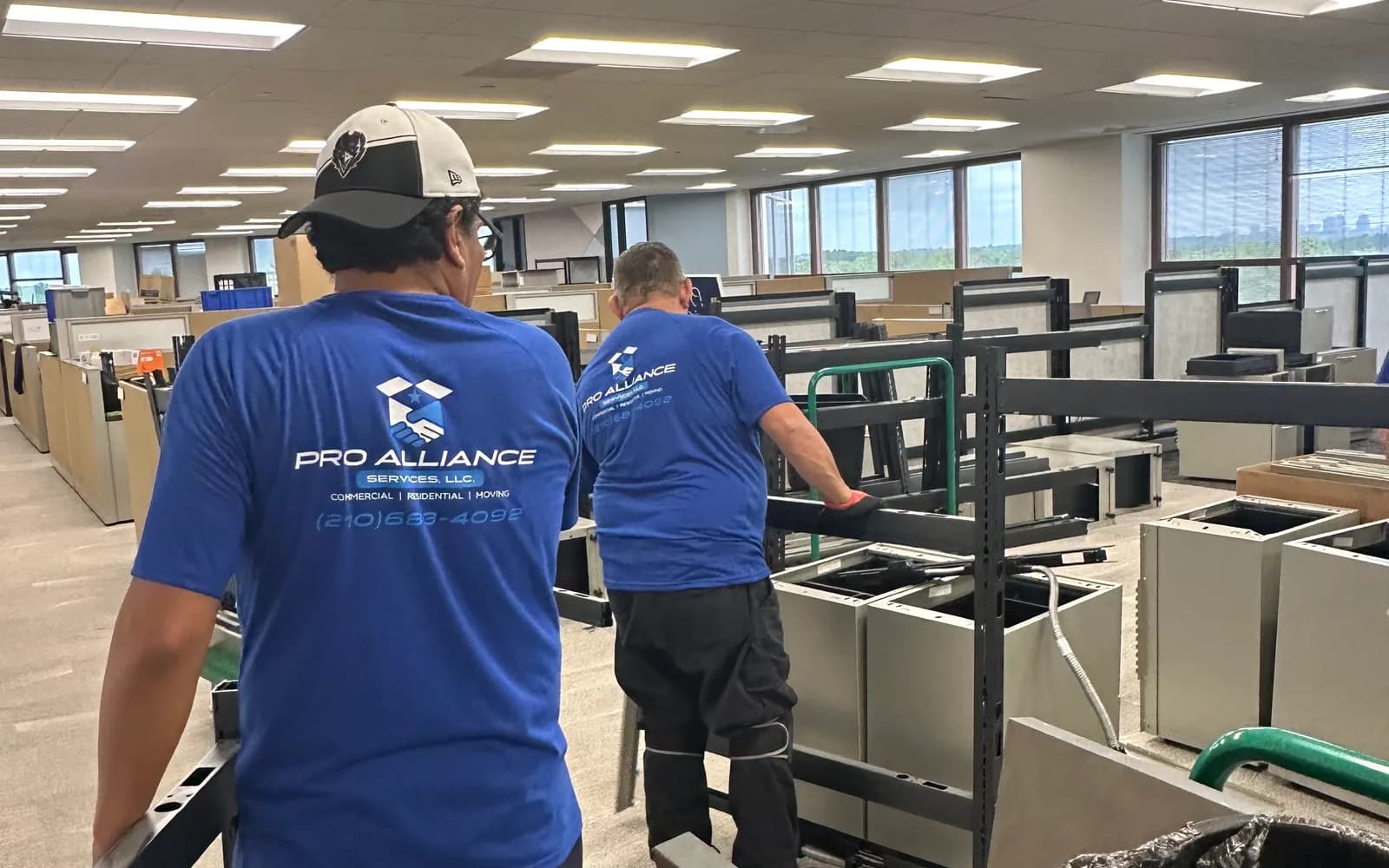
Workstations and cubicles. Systems furniture only resells when it is matching, complete, and recent enough for someone else to reinstall it, which is why buyers ask for station counts, panel sizes, and photos before they will quote a price. Whole stations sell; loose parts mostly do not. Once a run is incomplete or clearly dated, the metal goes to scrap recycling and the rest to disposal.
Task seating. Worn upholstery, a failed cylinder, or a missing caster is usually enough to send a task chair to disposal, since few buyers want to gamble on refurbishing seating. Clean chairs in working condition are the opposite story: every office needs them, so they are often the easiest item in the room to resell or donate.
Conference and breakroom furniture. Tables and guest chairs that are clean and undamaged tend to resell or donate without much trouble. The oversized boardroom table is the one exception worth flagging early, since a table assembled inside the room may not come apart, or go back together, in one piece.
Filing and storage. Lateral files, vertical files, and storage cabinets are heavy enough that the used market for them stays thin, though some liquidators buy them in bulk, some donation programs take them, and steel cabinets can always go to scrap metal. Empty every drawer and pull the keys before any of them leave the building.
Monitors and IT hardware. Computers, monitors, servers, desk phones, and networking gear all follow the electronics path below, and none of it gets routed anywhere until the storage on each device has been handled.
Appliances. Refrigerators need defrosting and drying before removal day, and anything with a water line needs a proper disconnection first. Once that is done, breakroom refrigerators, microwaves, and dishwashers can usually be resold or donated as long as they are clean and still working.
Signage. Interior and exterior signs are rarely worth anything to anyone but the business whose name is on them, so branded signage almost always ends up as disposal or recycling. Any required removal or wall repair is checklist work, covered on that side of the project.
What resells and what carries a removal cost
Resale value concentrates in a few places. Matching sets in good condition, in quantities a dealer can resell, attract offers. Recent task seating, complete workstation runs, and clean conference furniture lead that list. Condition matters more than age, and completeness matters more than either.
The removal side of the ledger is larger than most tenants expect. Mismatched odds and ends, worn seating, damaged pieces, heavy filing cabinets, and anything a buyer declines all become labor and hauling. A category can also flip from asset to cost by waiting, because buyers lose interest as the surrender date approaches and the pickup window shrinks.
Treat a liquidation offer as a bid on your timeline as much as on the furniture. An offer that includes pickup on a workable date is often the better offer. Whatever no buyer or program takes becomes removal scope, so plan for that work from the start.
Handle e-waste and data-bearing devices separately
Electronics cannot ride out with the furniture. Computers, servers, copiers, printers, and desk phones can hold company and customer data, and the data question has to be answered before the routing question.
Sanitize or remove the storage in every data-bearing device before it leaves the suite. Federal guidance exists for this step: the NIST Guidelines for Media Sanitization describe methods matched to how sensitive the information is. Your IT staff or IT vendor should own this work and document what was done to each device. Leased copiers and printers deserve the same attention, because many hold documents on internal drives and return to the leasing company rather than to a recycler.
For the hardware itself, Texas encourages keeping electronics out of the landfill through recycling. The TCEQ electronics recycling page describes manufacturer takeback programs for computers and televisions and lists additional recycling options. The EPA likewise recommends deleting personal information from devices before donation or recycling and removing batteries for separate handling. Lithium-ion batteries in particular should not go into regular trash or recycling bins.
Office-scale loads usually go through a commercial electronics recycler rather than a drop-off site. Ask what the recycler accepts, whether they pick up, and what documentation they provide for data-bearing equipment. Keep the sanitization records and the recycler paperwork together in the project file.
Sequence removal days with the building
Routing decides where things go. Sequencing decides when they leave, and the building has a say in both. Freight elevators, dock windows, and vendor rules apply to buyers' crews and recyclers just as they apply to movers, so every pickup needs a booked slot.
Order matters too. Resale pickups go first, while the furniture is intact and the buyer's window is open. Donation pickups follow. Recycling and disposal hauling go last, clearing whatever remains. A dedicated office decommissioning crew works around those vendor pickups, breaking down workstations, staging each group by destination, and hauling out what has no destination.
- List every furniture and equipment category with counts and condition notes, and photograph representative pieces.
- Mark which categories continue to the new office so they stay out of the routing plan.
- Send the workstation, seating, and conference inventory to liquidators and ask for offers that include pickup dates.
- Offer clean, usable pieces that buyers decline to donation programs, and confirm who transports them.
- Have IT sanitize or remove the storage in every data-bearing device and record what was done to each one.
- Book an electronics recycler for the remaining hardware and ask what documentation they provide.
- Reserve dock and freight elevator time with the building for each pickup and removal day.
- Schedule resale pickups first, donation pickups next, and recycling and disposal hauling last, all ahead of the surrender date.

If the wider relocation is still taking shape around the teardown, the San Antonio moving services guide sorts out which crew handles which part. Once the routing plan is set, request an estimate that lists the teardown, staging, and haul-away work by category, so the scope reflects what is actually leaving the space.
Where Pro Alliance fits
Teardown, staging, and haul-away are scoped around wherever your buyers, donation programs, and recyclers land, which is what Pro Alliance's office decommissioning service exists to absorb. With the surrender date, the category inventory with counts and photos, and the building's access rules in hand, request an estimate so the review covers the actual project.
Frequently asked questions
Is used office furniture worth selling before a move-out?
It depends on condition, completeness, and quantity. Matching sets of recent workstations, task chairs, and conference furniture in clean condition attract liquidators, especially in volume. Single pieces, worn items, and dated systems usually do not.
Ask a liquidator early, with photos and counts. Even an early no is useful, because it moves the category to donation or disposal while time remains.
What do liquidators need before making an offer?
Counts, photos, and condition notes, grouped by category. For workstations they also want panel sizes and whether each station is complete. Share the surrender date up front, and confirm who handles teardown and loading, since offers often assume one side or the other.
Can office electronics go in the regular trash?
Treat electronics as a separate stream. Texas encourages recycling electronics rather than sending them to the landfill, and manufacturer takeback programs exist for computers and televisions. Batteries need separate handling, and lithium-ion batteries should not go into regular trash or recycling bins.
For an office-scale load, a commercial electronics recycler is the practical route. Data-bearing devices must be sanitized before anything is picked up.
Who is responsible for wiping data before equipment leaves?
The business is, before any device leaves its control. IT staff or an IT vendor should sanitize or remove storage and document what was done to each device, following federal media sanitization guidance. That includes copiers and printers with internal drives, not just computers. If a recycler offers destruction services, ask what documentation they provide before pickup.
What happens to cubicles that nobody buys?
They come apart and leave in pieces. Steel frames and panels can go to scrap metal recycling, and the rest leaves as disposal. Complete stations are worth offering to buyers and donation programs first, because a station that can be reinstalled has a second life and a station in pieces does not. Whatever remains becomes teardown and haul-away scope.
Sources
Ready to plan the real move?
Send both addresses, your date, and what you are moving. The team reviews access at each end and comes back with a written estimate.
Prefer to talk it through? Call (210) 683-4092, Mon–Fri 8:00 AM–5:30 PM and Sat–Sun 8:00 AM–4:30 PM.
Keep planning