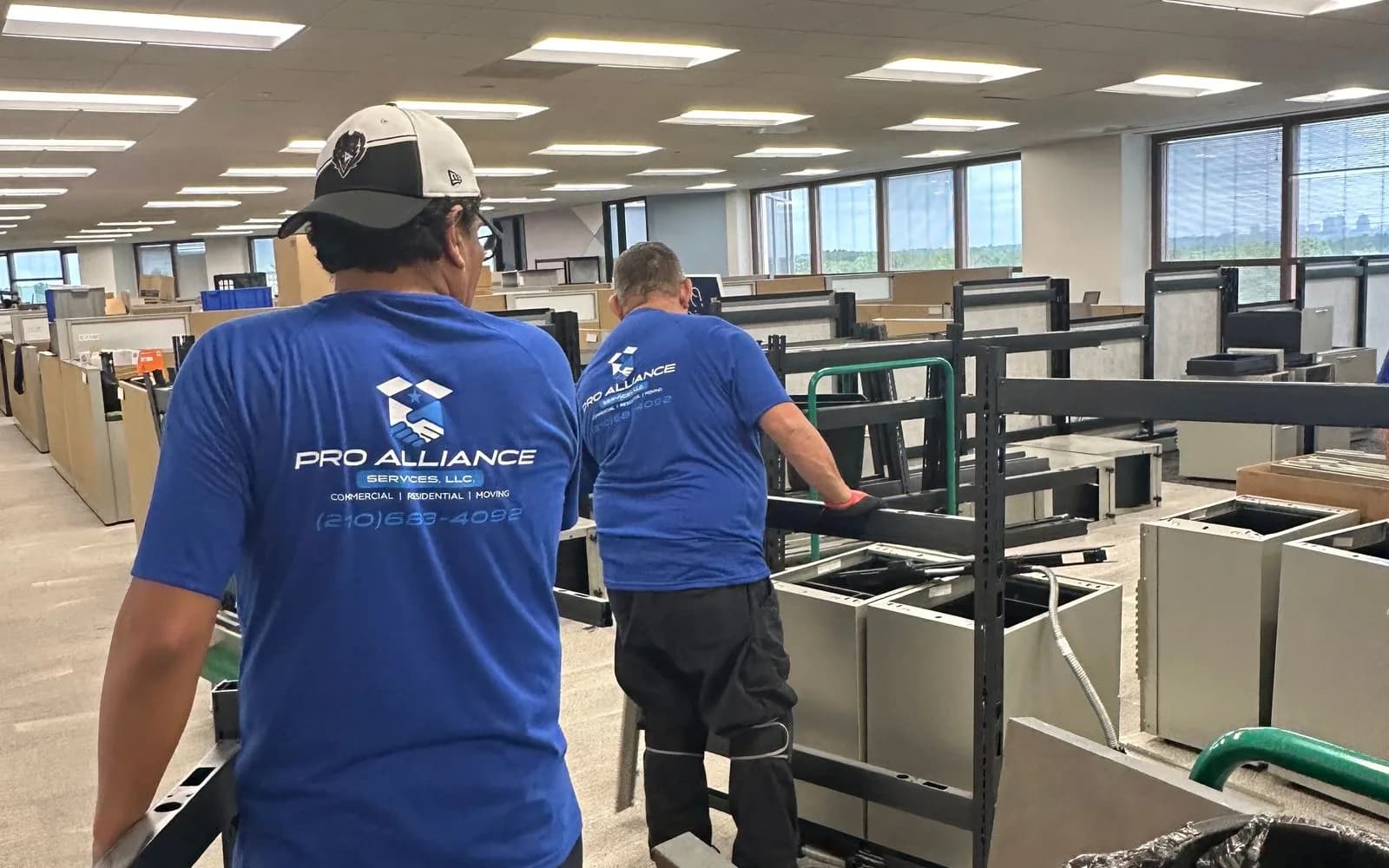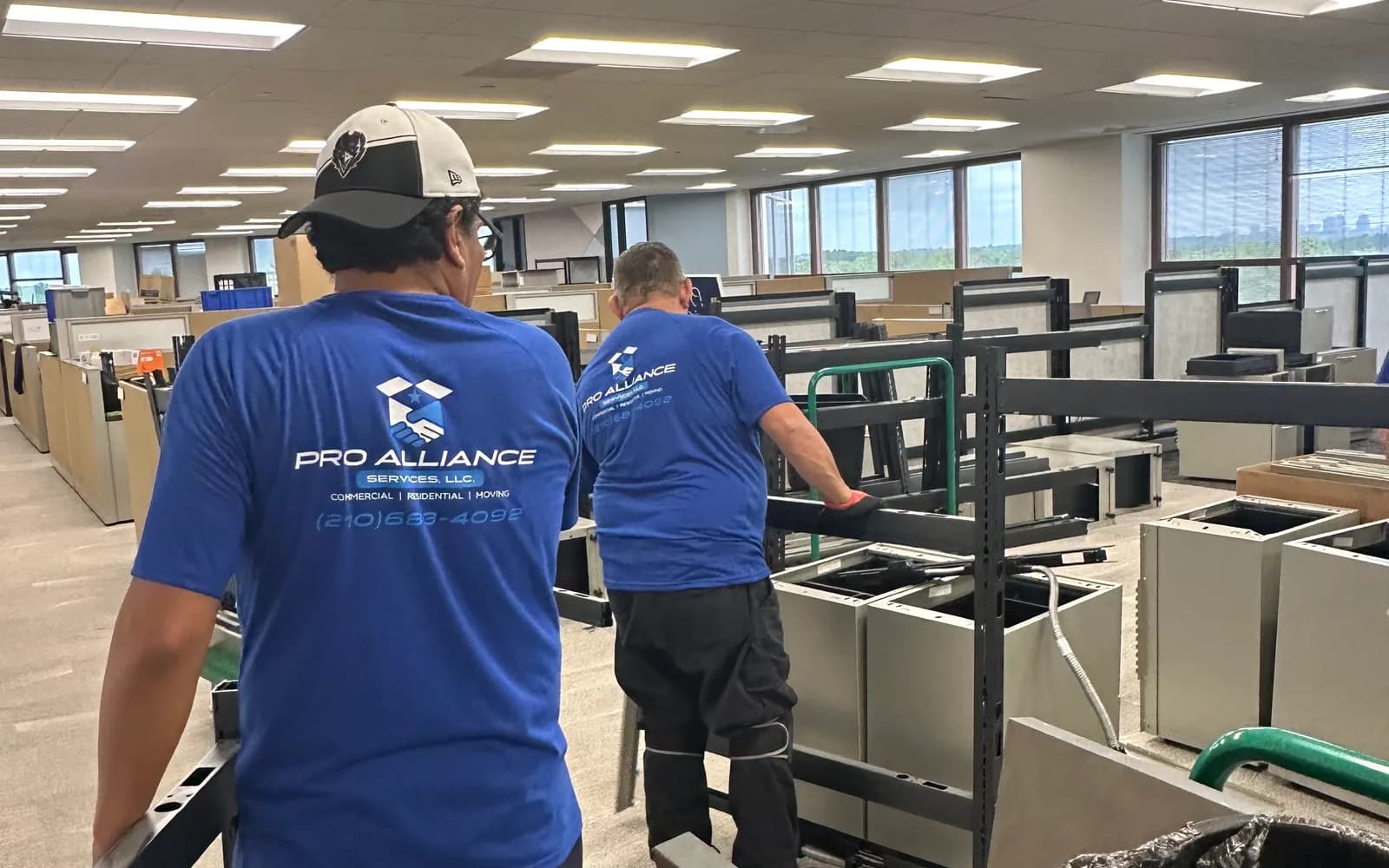
Hiring a mover for a business is a different decision from hiring one for a house. The furniture is heavier and more standardized, the buildings have rules of their own, and every hour the office is packed is an hour the business is not working normally. A cheap bid that ignores the loading dock or the IT closet is not cheap for long.
This guide covers the hiring decision itself. It explains which registrations to look up, what the buildings will ask the mover for, what a walkthrough should produce, and how to read a written scope so two bids compare fairly. The day-by-day sequencing of an office move, from dock reservations to labeling desks to a floor plan, sits in our office move planning guide. If the business is leaving a space for good, the exit work is covered separately under office decommissioning.
Direct answer: Hire a commercial mover in San Antonio by checking three things before comparing any number. First, look up the company's state registration and confirm the truck that arrives will carry the same name. Second, ask both buildings what paperwork a vendor owes them and make sure the mover can supply it. Third, insist on a walkthrough and a written scope that lists every task, including who disconnects the computers.
Short answer: what should you check before hiring a commercial mover?
Start with the registration. The Texas Department of Motor Vehicles runs a public lookup, and a licensed Texas mover shows an active certificate there. Next, call the property manager at each building and ask what a moving vendor must provide before work starts, usually a certificate of insurance naming the building and a reserved dock or elevator time. Then have each mover you are considering walk the space, or review a detailed video, and return a written scope. Compare the scopes line by line: packing, crates, furniture disassembly, IT disconnection, labeling, reinstallation, debris removal, and after-hours work. A bid that leaves a line blank has not priced it.
Look up the registration before anything else
Texas movers that carry household goods must be licensed with the TxDMV, and the agency's own advice is to check a company in its Truck Stop lookup before hiring it. An active certificate number is what you are looking for. The same page lists the warning signs of an unlicensed operator, and two of them matter for a business move: an unmarked or rented truck, and no written proposal before loading. TxDMV requires licensed movers to show their name, TxDMV certificate number, and USDOT number on both sides of the truck.
Commercial jobs blur the categories a little, because office furniture is not household goods in every sense. That does not change the practical test. A company that runs trucks on Texas roads under its own authority has public numbers you can check in a minute, and a company that cannot give you those numbers is telling you something. Pro Alliance Services LLC operates under USDOT 3348909, MC 1132579, and TxDMV 010320594C. Look them up the same way you look up anyone else.
Ask one more question at this stage: will your own crew do the work, or is the job passed to another company? Brokered moves are common, and a business owner deserves to know who is actually carrying the conference table. Our general guide to verifying a licensed Texas moving company walks through the lookup screen by screen.
Find out what each building will require from the mover
Office buildings treat a move as vendor work. Before a crew can use the freight elevator or the dock, the property manager usually wants paperwork, and the destination building is often stricter than the one you are leaving, because it has no history with you.
Ask both property managers the same questions, and ask for the answers in writing:
- What certificate of insurance does a moving vendor need to provide, and who must be named on it?
- How is the loading dock reserved, and how long is each window?
- Does the freight elevator need a reservation, padding, or an attendant?
- Which hours are moves allowed, and does after-hours work need security notice?
- Are there floor or wall protection rules for the corridors?
Send those answers to every mover you are considering. A mover who reads them and asks follow-up questions is showing you how the actual day will go. A mover who never asks about the buildings is going to find out about them at seven in the morning with the truck at the curb.
Ask for a walkthrough and a scope you can compare
A number given over the phone for "a twenty-person office" is a guess. The honest version is a walkthrough of the space, or a thorough video if the schedule is tight, followed by a written scope. TxDMV's consumer guidance makes the same point for any move: get the proposal in writing before loading, and do not rely on verbal agreements.
The scope is where bids differ, so read each one against the same list:
- The written scope names every room, floor, and storage area included, and anything excluded is stated plainly.
- Packing is defined, including who supplies crates or boxes and when they arrive.
- Furniture disassembly and reassembly are listed, with systems furniture and cubicles called out separately.
- IT disconnection and reconnection are assigned to a named party, whether that is your IT provider or someone else.
- The labeling method ties each desk, crate, and chair to a position on the new floor plan.
- After-hours or weekend work is stated, along with the building windows it depends on.
- Debris, packing material, and unwanted furniture have a stated destination after the move.
- The proposal states whether it is binding or not to exceed, which are the two forms TxDMV describes.
If two bids cover different lists, they are not comparable yet. Send each mover the missing lines and ask them to revise. That one round of questions usually tells you more about a company than the bid itself.
Decide who handles the technology and the leftovers
Two parts of a commercial move sit on the boundary of what a moving crew does, and they cause most of the Monday morning problems.
The first is technology. Movers carry computers, monitors, printers, and servers, but disconnecting a network, labeling cables, and bringing systems back online is usually your IT provider's job. Settle this in writing. Somebody has to photograph the connections before anything is unplugged, and somebody has to be on site at the destination to plug it back in. If the mover is expected to do any of that, it belongs in the scope.
The second is what stays behind. Old desks, broken chairs, and retired electronics do not disappear when the truck leaves. Texas law requires computer and television manufacturers to offer recycling for their products, and TCEQ points businesses and households toward those programs and other recyclers. Decide early which items are going to the new space, which are going to recycling or donation, and which need removal. Our guide to office furniture liquidation in San Antonio covers the options for surplus furniture.
Compare bids without being misled by the total
The lowest total is easy to spot and easy to misread. TxDMV warns that an unlicensed operator may quote low and raise the price once items are on the truck. Among licensed movers, a low number more often means a narrower scope. It may leave out IT support or reassembly, send fewer people, or assume the building will let the truck work during business hours when it will not.
Put the bids side by side and check each line of the scope list above. Ask each mover how many people and trucks they plan to send, and how many hours they expect the job to take. Then ask what happens if the dock window runs out before the truck is empty. There is no single right answer, but there should be an answer.
Timing matters too. If the move has to happen over a weekend so the business opens on Monday, say so at the start. Our commercial movers in San Antonio page explains how we plan around operating hours, and the furniture installation service covers workstations and systems furniture that need to go back up to a floor plan. If the new space is being furnished from scratch by several vendors, read how FF&E installation in San Antonio works before you schedule anything.
Where Pro Alliance fits
Send us the addresses of both buildings, the property managers' requirements, a rough headcount, and any floor plan you have. We will arrange a walkthrough and return a written scope for the commercial move you actually have. Start with the free estimate form and mention the date the business needs to be running again.
Frequently asked questions
Do commercial movers in Texas need a state license?
Texas requires movers of household goods to be licensed with the Texas Department of Motor Vehicles, and the agency publishes a lookup for checking a company. For any business move, ask for the mover's TxDMV and USDOT numbers and look them up before signing.
What is a certificate of insurance for a moving vendor?
It is a document from the mover's insurer showing its coverage, often naming the building owner or manager. Many office buildings ask for one before a moving crew can use the dock or elevator. Ask each property manager for the exact wording they need.
Should the movers disconnect our computers and network?
Usually your IT provider handles network disconnection and reconnection, while the movers pack and carry the equipment. Agree on this in writing before the move and make sure someone is at the new office to bring systems back online.
How far ahead should a business book a commercial move?
Start as soon as the lease dates are set. The building reservations, the walkthrough, and the scope review all take time, and weekend dates near the end of a month tend to fill first. Earlier planning gives you more choice of dates.
Can a commercial move happen after business hours?
Often, if the buildings allow it. Many properties restrict move hours or require security notice for evenings and weekends. Confirm the permitted hours with both property managers first, then ask the mover to plan the work inside those windows.
Sources
Ready to plan the real move?
Send both addresses, your date, and what you are moving. The team reviews access at each end and comes back with a written estimate.
Prefer to talk it through? Call (210) 683-4092, Mon–Fri 8:00 AM–5:30 PM and Sat–Sun 8:00 AM–4:30 PM.
Keep planning